
Robotics for Facility Management in Hospitals and Healthcare Facilities
Healthcare providers face immense pressure to maintain sterile, efficient, and welcoming environments. Robotics in healthcare facilities solve these operational challenges by automating routine tasks and improving overall hygiene. Facility managers now rely on advanced machines to handle logistics, cleaning, and security round the clock.
You can transform how your medical center operates by integrating smart robotic systems. Hospital facility management robots take over repetitive physical labor, allowing human staff to focus strictly on patient care. This shift drastically improves both staff satisfaction and patient outcomes.
This guide explores the exact technologies upgrading medical centers across the UAE and GCC. We will cover the specific types of robots available, their financial benefits, and how Ednex Automation implements these systems.
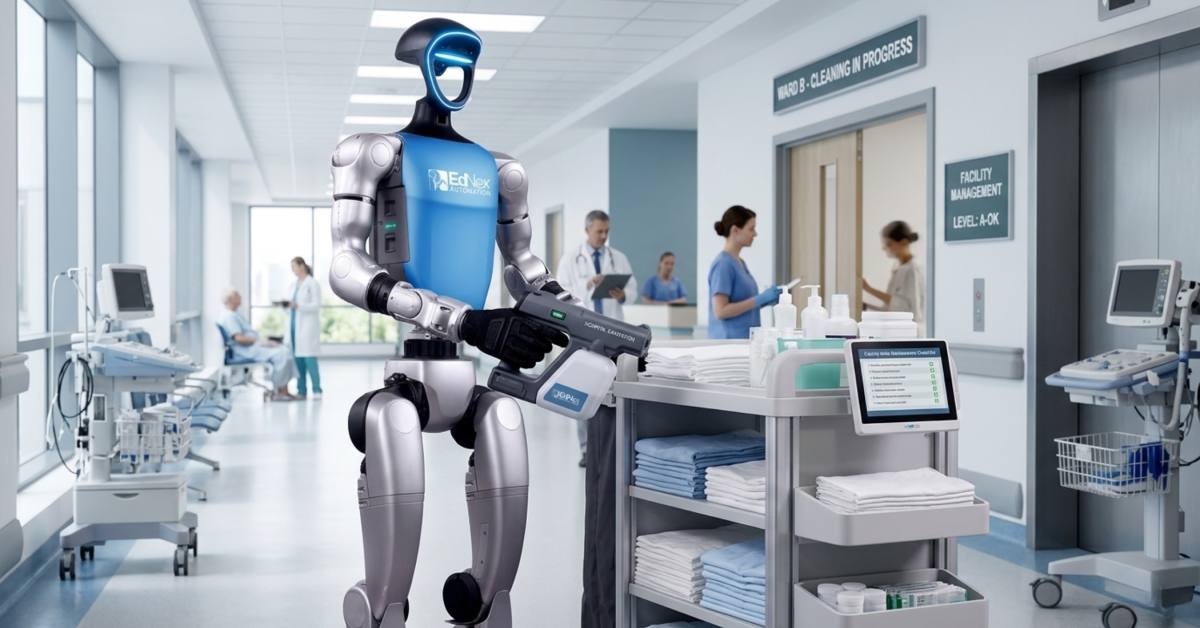
The Shift Toward Robotic Automation in Healthcare
Medical centers require flawless facility management to prevent infections and ensure smooth patient flow. Robotic automation in healthcare provides the reliability and precision that manual labor simply cannot guarantee 24/7. These autonomous systems follow exact programming to clean floors, deliver supplies, and monitor secure areas.
Human error in hospital cleaning or logistics can lead to severe health consequences. Healthcare facility management technology eliminates these risks by performing tasks with absolute consistency. Sensors and artificial intelligence guide these machines safely through crowded corridors without disrupting medical workflows.
Implementing these systems instantly modernizes your infrastructure. Patients and their families immediately notice the presence of advanced technology, which builds trust in your medical institution’s capabilities.
Core Benefits for Facility Managers
Facility managers gain unprecedented control over their building’s daily operations through centralized software dashboards. Robots in hospitals report their status, location, and task completion rates in real-time.
- Continuous Operation: Robots work night shifts without fatigue or overtime pay.
- Data-Driven Management: Managers receive detailed analytics on cleaning routes and delivery times.
- Enhanced Safety: Machines handle hazardous waste and harsh cleaning chemicals safely.
- Staff Retention: Nurses and orderlies avoid burnout by offloading heavy lifting to machines.
Key Applications of Hospital Facility Management Robots
Robotics seamlessly integrate into almost every aspect of a hospital’s non-clinical operations. Hospital service robots handle the heavy lifting, precise cleaning, and rapid transport required in massive medical complexes.
You can deploy specialized machines tailored to your facility’s specific operational bottlenecks. From the pharmacy to the surgical ward, robots provide targeted support where your staff needs it most.
Automated Cleaning and Disinfection
Maintaining clinical-grade cleanliness is the top priority for any hospital facility manager. Autonomous floor scrubbers navigate complex hospital layouts to clean large lobbies, hallways, and waiting rooms. They use advanced water recycling systems to clean massive areas efficiently without leaving slippery floors behind.
UV-C disinfection robots offer an essential second layer of protection against hospital-acquired infections (HAIs). These machines enter empty patient rooms or surgical suites and blast high-intensity ultraviolet light. This light destroys the DNA of harmful bacteria and viruses on all exposed surfaces within minutes.
Medical Supply and Logistics Delivery
Nurses spend countless hours walking to pharmacies and supply closets instead of attending to patients. Healthcare service robots feature secure, locked compartments to transport sensitive medications, blood samples, and sterile surgical tools. They navigate securely between departments, ensuring critical items arrive exactly when needed.
These delivery units integrate directly with the hospital’s elevator and automatic door systems. When a doctor orders a specific lab kit, the robot fetches it and navigates multiple floors autonomously. This rapid point-to-point delivery speeds up diagnosis and treatment times significantly.
Linen and Heavy Transport
Large hospitals generate tons of soiled linens and require constant restocking of fresh supplies. Heavy-duty transport robots hook into large carts and tow them from the laundry facility to specific ward storage rooms. This prevents workplace injuries associated with staff pushing heavy carts over long distances.
Waste Management and Handling
Disposing of biohazardous waste requires strict adherence to safety protocols. Specialized robotic units transport hazardous materials from designated drop-off points to disposal areas without human contact. This minimizes the risk of cross-contamination and protects your janitorial staff from dangerous exposure.
Enhancing Patient Care with Healthcare Service Robots
While clinical staff handle medical treatments, robots vastly improve the secondary aspects of the patient experience. Healthcare service robots guide lost visitors, deliver meals, and provide a welcoming presence in stressful environments.
Hospitals are notoriously difficult to navigate, causing immense stress for arriving patients. Wayfinding robots greet visitors at the entrance, ask for their destination, and physically lead them to the correct clinic. This reduces crowding at reception desks and ensures patients arrive at their appointments on time.
Automated Dietary Delivery
Nutrition plays a vital role in patient recovery, but delivering hot meals to hundreds of rooms simultaneously is challenging. Delivery robots navigate ward corridors to distribute patient meals efficiently. They maintain the correct food temperatures and ensure dietary restrictions are strictly followed through barcode verification.
Companionship and Entertainment
Pediatric wards increasingly use friendly, interactive robots to reduce children’s anxiety before procedures. These machines play games, tell stories, and explain medical processes in simple, non-threatening ways. Happy, relaxed patients are easier to treat and typically experience faster recovery times.
Evaluating the Financial Impact and ROI
Upgrading to healthcare facility management technology requires a capital investment, but the return on investment (ROI) is rapid. Hospitals save massive amounts of money by reducing waste, lowering staff turnover, and minimizing infection-related liabilities.
You save directly on labor costs by reallocating your human workforce to higher-value, specialized tasks. A single delivery robot can perform the walking equivalent of three full-time orderlies across multiple shifts.
Reducing Hospital-Acquired Infections
Treating HAIs costs medical facilities millions of dollars annually and ruins institutional reputations. UV-C disinfection robots drastically lower infection rates by ensuring operating rooms are perfectly sterile. Preventing just a few severe infections entirely covers the cost of purchasing the robotic equipment.
Lowering Employee Turnover
Nursing shortages plague the global healthcare industry, making staff retention critical. By deploying hospital service robots to handle mundane tasks, nurses spend their time doing what they love: treating patients. Better working conditions lead to higher job satisfaction and significantly lower recruitment and training costs.
Ednex Automation: Leading Healthcare Robotics in the GCC
Implementing complex automation in medical centers requires an experienced, localized partner. Ednex Automation provides tailored robotics solutions for hospitals and healthcare facilities across the UAE and the wider GCC. We understand the strict regulatory requirements and unique operational challenges of regional medical centers.
We do not just sell hardware; we engineer comprehensive facility management ecosystems. Our team audits your hospital’s layout, network infrastructure, and daily workflows before recommending any equipment. We ensure that every robot we deploy solves a specific, measurable problem for your facility.
Custom Software Integration
Robots must communicate perfectly with your existing hospital information systems (HIS). Our software engineers integrate robotic platforms with your elevator controls, electronic health records, and fire alarm systems. This ensures seamless, safe operation during both normal routines and emergency situations.
Comprehensive Training and Support
Your staff must feel completely comfortable working alongside autonomous machines. Ednex Automation provides extensive on-site training for nurses, doctors, and facility managers in the UAE. We teach your team how to operate, dispatch, and perform basic troubleshooting on every robotic unit.
Rapid Local Maintenance
Hospital equipment cannot afford downtime. Our localized GCC support teams provide rapid, on-site maintenance and repairs to keep your fleet running 24/7. We maintain a robust inventory of spare parts in the UAE to guarantee immediate fixes when needed.
Preparing Your Facility for Robotic Integration
Successful robotic deployment requires thoughtful preparation and infrastructure updates. You must ensure your hospital has strong, consistent Wi-Fi coverage across all operating zones so robots remain connected. Dead zones can cause autonomous units to stall, disrupting vital delivery routes.
Clear pathways and standardized storage areas help machines navigate without constant recalibration. Facility managers should standardize the carts, bins, and doors that the robots will interact with daily. Simple physical adjustments drastically improve the speed and efficiency of your new automated workforce.
Starting with a Pilot Program
We recommend introducing robotics in healthcare facilities through a focused pilot program. Start by automating a single workflow, such as transporting lab samples from the emergency room to the pathology lab.
Once your staff sees the reliability of the system, adoption becomes eager rather than resistant. You can then scale the technology across different departments, expanding into cleaning, heavy transport, and patient assistance.
Conclusion
The future of medical operations relies heavily on smart, autonomous systems. Robotics in healthcare facilities guarantee higher hygiene standards, faster internal logistics, and vastly improved patient experiences. By taking the physical burden off your human staff, you elevate the standard of care your hospital provides.
Medical centers in the UAE and GCC must adopt these technologies to remain globally competitive. Ednex Automation stands ready to guide your facility through this critical digital transformation. Contact us today to schedule a comprehensive robotics audit for your healthcare institution.
Frequently Asked Questions
Hospital facility management robots are autonomous machines designed to handle non-clinical operations inside medical centers. They perform essential tasks like floor scrubbing, UV-C disinfection, heavy linen transport, and secure waste disposal without human intervention.
Robotics in healthcare facilities take over repetitive physical tasks like delivering lab samples, fetching medications, and guiding visitors. This frees up doctors and nurses to spend more direct, quality time treating patients and improving medical outcomes.
Yes, robots in hospitals are incredibly safe. They use advanced 3D sensors, LIDAR, and artificial intelligence to detect moving people, medical equipment, and sudden obstacles. They instantly stop or reroute to prevent collisions in busy corridors.
Healthcare service robots handle the internal logistics of a medical center. They securely deliver meals, transport sensitive pharmaceuticals with locked compartments, and provide wayfinding assistance to lost visitors, ensuring smooth daily operations.
Ednex Automation provides complete end-to-end support for robotic automation in healthcare across the UAE and GCC. We handle facility audits, custom software integration with hospital systems, staff training, and 24/7 local maintenance.