
Humanoid Robots in Universities: Transforming Academic Research and Education
You’ll immediately notice a major shift in learning when you visit a leading university lab. Today, universities are moving beyond traditional textbooks and static software. Departments are now integrating advanced, human-like robots directly into classrooms to boost real-world, hands-on learning.
These changes give students direct access to cutting-edge technology. Learners can see their code come to life as robots execute instructions in real time. This evolution accelerates their understanding of programming, mechanics, and artificial intelligence.
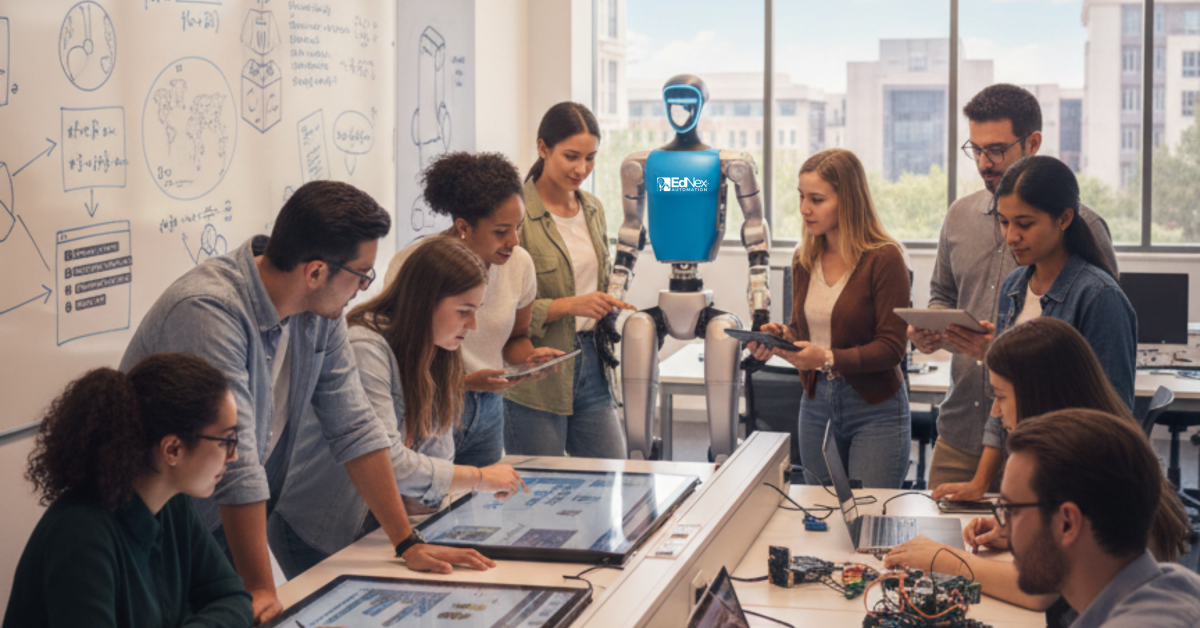
Humanoid robots in universities are revolutionizing student learning by providing an interactive, hands-on platform for testing complex theories. Students can write code and instantly see a physical robot put their instructions into action.
This immediate feedback deepens understanding of mechanics, programming, and artificial intelligence. Practical experience with robots makes lessons more engaging and memorable, giving students the skills they need for future tech-driven careers.
This guide explains how humanoid robots are reshaping higher education. You’ll discover the latest educational robotics technology, see real-world examples with Unitree G1 and Unitree H1, and learn how Ednex Automation is leading innovation across the UAE and GCC.
Each section highlights the transformational impact of robots in academic settings, from classrooms to advanced research labs. Explore how these technologies support both students and institutions in building future-ready skills.
The Rise of Robots in Higher Education
Universities are facing pressure to make engineering curriculums relevant in a rapidly changing world. As industries adopt automation, graduates must be ready to work with advanced machines.
Robots in higher education are the key solution. By simulating real-world industrial environments, humanoid robots give students hands-on experience right on campus. This prepares future professionals to meet market demands without extensive retraining.
Humanoid robots immediately boost student interest when integrated into university syllabi. Their human-like appearance and movement make them highly relatable and engaging.
Students shift from passive learning to active problem-solving. They troubleshoot mechanical issues, optimize battery performance, and refine robot movements—all first-hand.
This real-world application accelerates technical growth. Learners build practical skills while preparing for innovative roles in a technology-driven workforce.
Bridging the Gap Between Theory and Practice
Bridging the gap between theory and practice is essential in higher education. Theoretical subjects like physics and computer science can feel distant without practical application.
Humanoid robots in education offer a concrete solution. They act as a link between complex mathematical concepts and real-world actions. For example, when a student writes an algorithm for balance, they immediately see if the robot stands or falls.
This real-time feedback helps students understand abstract ideas. It allows them to test, observe, and refine their knowledge, making learning more engaging and effective.
Immediate feedback from humanoid robots accelerates student learning. When students see robots respond instantly to their code, they confront real-world concepts like gravity, friction, and kinetic energy.
Practical demonstrations highlight where theory meets reality. Unlike software simulations, hands-on robotics require students to adapt and problem-solve in real time, deepening their technical skills.
Short, intense learning loops keep engagement high. Each adjustment or failure teaches valuable lessons, making robotics an ideal tool for building confidence and expertise in STEM education.
Enhancing Robotics in Academic Research
Humanoid robots are now driving innovation beyond the undergraduate classroom. In academic research, flexibility and adaptability are crucial for success. Robotics in academic research depends on platforms that can handle a range of complex tasks.
Humanoid robots provide unparalleled versatility for faculty and post-graduate studies. Researchers use these robots to push the limits of scientific discovery, thanks to their ability to perform diverse roles in various research settings.
Unlike single-purpose machines, humanoid robots serve as multifunctional data-gathering tools. Their human-like joints and sensors enable precise navigation and interaction in environments designed for people. This adaptability helps researchers achieve more accurate results and explore new scientific frontiers.
Researchers now maximize efficiency by using humanoid robots as multi-functional data-gathering tools. These robots, equipped with human-like joints and advanced sensors, adapt seamlessly to spaces designed for people.
Humanoid robots handle tasks traditional machines cannot. They climb stairs, open doors, and operate standard laboratory equipment with remarkable precision.
This flexibility enables more accurate and ambitious research. With one versatile robotic platform, universities avoid the need to build custom robots for every experiment, saving time and costs while boosting research output.
Upgrading Humanoid Robots in Research Labs
Humanoid robots in research labs are revolutionizing the way universities develop and test robotics software. These platforms give researchers a reliable, human-like form to advance computer vision, improve natural language processing, and refine movement algorithms.
Researchers benefit from having a consistent hardware foundation. They can focus on their experiments and software without the time-consuming need to build new robots for every project. As a result, universities can accelerate research timelines, publish results faster, and attract more funding for future innovation.
Using a reliable hardware platform, researchers save thousands of hours on development. Instead of creating custom robots for every project, they use humanoid robots that can be programmed for specific experiments and studies.
This approach streamlines research tasks and improves efficiency. Universities can publish findings faster and secure funding more quickly, thanks to these adaptable robotic platforms.
By reducing time spent on hardware, teams focus more on innovation and data analysis. This shift not only boosts productivity but also accelerates scientific discovery across multiple disciplines.
Key Benefits of Humanoid Robots in Education
Integrating advanced robotics into academic programs provides major benefits for both students and institutions. These advantages help universities stay competitive and better prepare learners for future careers.
Key benefits include:
- Accelerated Skill Development: Students quickly gain hands-on experience with hardware and software, making learning faster and more practical.
- Enhanced Cross-Discipline Collaboration: Learners from computer science, engineering, and psychology can work together on a single humanoid platform, promoting teamwork across fields.
- Increased Student Engagement: Direct interaction with robots keeps students motivated and focused on real-world problem-solving.
- Better Career Readiness: Graduates leave with practical skills using the same machines found in leading industries, increasing their employability.
- Stronger Research Portfolios: Universities that provide access to state-of-the-art robotics attract top talent and secure valuable research grants.
These benefits show why humanoid robots in universities are now at the forefront of educational innovation.
- Accelerated Skill Development: Students gain immediate, hands-on experience with hardware and software integration.
- Enhanced Cross-Discipline Collaboration: Computer scientists, mechanical engineers, and cognitive psychologists can all work together on a single humanoid platform.
- Increased Student Engagement: Working with physical robots keeps students highly motivated and focused on complex problem-solving.
- Better Career Readiness: Graduates enter the workforce with practical experience managing the exact machines used in modern industries.
- Stronger Research Portfolios: Universities attract top talent and massive research grants by providing access to state-of-the-art robotics.
Spotlight on Educational Robotics Technology: Unitree G1 and H1
Universities need robotics hardware that is durable, programmable, and cost-effective. That’s why Unitree has become a global leader in academic robotics technology. Their newest models deliver unmatched performance and flexibility for today’s university classrooms and labs.
Unitree robots are built to withstand demanding academic environments. Both students and faculty benefit from open-source programming options, easy customization, and robust design. This means universities can confidently expand their robotics programs while keeping costs manageable.
Academic institutions gain powerful learning and research tools. With Unitree’s advanced hardware, educators foster innovation and hands-on technical skills, preparing students to excel in technology-driven careers.
The Unitree G1 and Unitree H1 set the standard for robotics in higher education. Both models provide open-source programming, letting students and researchers modify nearly every aspect of robot behavior.
Key reasons these models are essential:
- Open-source flexibility: Students easily adapt and program the robots for a wide variety of experiments.
- Built for education and research: Both G1 and H1 are designed to meet the demands of real-world university use.
- Versatile application: These robots work in classrooms, labs, and research centers across engineering, computer science, and more.
Choosing Unitree G1 and H1 helps universities stay ahead in robotics and nurture hands-on learning and research.
The Agile Unitree G1
The Unitree G1 is a compact, highly agile humanoid robot designed for research and education. Its small size makes it safe and practical in busy campus labs.
Key advantages of G1:
- Safe to use in crowded settings, reducing accident risks.
- Highly flexible joints and dynamic balance make it ideal for challenging tasks.
- Affordable pricing means universities can buy several units, allowing students more hands-on access.
Students can easily program the G1 to cross uneven terrain or pick up delicate objects, boosting their technical skills through practical experience.
Despite its compact design, the G1 boasts impressive joint flexibility and advanced dynamic balance. Students can program the G1 for challenging tasks, including walking over rough ground and picking up fragile objects.
Affordability is a major advantage of the G1. Universities can purchase several units, which ensures that every student gets valuable, hands-on experience with real robotics.
Hands-on access increases learning outcomes and student confidence. With more robots available, more learners can engage directly with advanced robotics technology in a safe, collaborative lab environment.
The Powerful Unitree H1
The Unitree H1 delivers a full-sized, high-power platform for advanced research. This robot represents the cutting edge of modern humanoid engineering, equipped with high-torque motors for strength and advanced LiDAR sensors for deep, accurate environmental mapping.
Key features of the H1 include:
- Exceptional power and stability even during demanding experiments.
- Advanced sensors support navigation and mapping for complex applications.
- Ideal for heavy-duty research in engineering, robotics, and artificial intelligence.
The H1 enables universities to expand their research capabilities, making it indispensable for top engineering and research faculties.
The Unitree H1 is trusted by researchers for high-demand applications. This robot is ideal for developing complex navigation systems, especially for tasks like search and rescue.
Exceptional stability and power set the H1 apart. It supports studies in advanced bipedal locomotion and other challenging research areas.
Top engineering faculties value the H1 for its reliability. With the H1, universities can publish groundbreaking research and expand their reputation in robotics innovation.
AI Robots in Universities: A Catalyst for Innovation
Artificial intelligence and robotics are inseparable in higher education. You need advanced AI to power smart robots, and robots give AI a physical form to engage with the real world.
AI robots in universities bring data-driven learning to campus. Students can load their machine learning algorithms into humanoid robots and immediately watch how the robot responds, learns, and adapts.
This hands-on approach allows students to link classroom concepts directly to real-world results. By seeing their AI models at work, learners gain practical skills that are critical for modern STEM careers.
Students use humanoid robots in universities to test and refine their neural networks in real time. By loading a new AI model onto the robot, they can immediately see how the system performs with actual movements and responses.
The robot’s cameras and sensors collect real-world data and feed it back into the neural network. This hands-on approach allows students to observe how their algorithms adapt and improve with every iteration.
Continuous data collection and behavioral adjustment are essential to real artificial intelligence. These learning cycles show students the dynamic process behind intelligent machines, helping them master both theoretical and practical AI skills.
Advancing Machine Learning and AI
Humanoid robots offer the ideal platform for practical machine learning. These robots excel at teaching AI to handle unpredictable, real-world conditions. When a robot faces a new obstacle, its AI must instantly calculate a safe new route.
Universities leverage these challenges to improve deep learning techniques. By programming AI models to operate humanoid robots, students gain direct experience coding for latency, sensor noise, and hardware constraints. This hands-on exposure gives graduates real-world skills highly valued by global tech leaders.
Universities refine deep learning algorithms by putting AI models into action with real robots. When students program AI to operate a physical humanoid robot, they immediately encounter practical challenges like latency, sensor noise, and hardware limitations.
This real-world exposure is vital for mastering advanced AI skills. By testing and debugging their code on actual machines, students build crucial problem-solving abilities that go beyond theoretical lessons.
Global tech companies value this experience. Employers seek graduates who can handle both the coding and hardware integration required in modern robotics, making these skills highly marketable for future careers.
Ednex Automation: Empowering the UAE and GCC
Choosing the right technology partner is crucial for academic innovation. Ednex Automation stands out as the leading expert in advanced robotics for education across the Middle East.
Based in the UAE, Ednex Automation is the premier provider of academic robotics solutions throughout the GCC. Their deep technical expertise ensures seamless integration for universities seeking to modernize learning environments.
With Ednex Automation, institutions gain more than hardware. They receive comprehensive support, training, and guidance—helping universities successfully transform their programs with cutting-edge robotics technology.
The educational sector across the UAE, Saudi Arabia, Qatar, Oman, Bahrain, and Kuwait is rapidly expanding. Regional governments are making substantial investments in STEM education to foster knowledge-based economies.
Ednex Automation delivers the advanced technology needed for these ambitious goals. Universities partner with Ednex to access state-of-the-art robotics that drive innovation and support their academic vision.
Transforming Regional Campuses
Ednex Automation provides end-to-end support for universities adopting humanoid robots. They partner directly with institutions to integrate Unitree G1 and H1 robots into curriculums.
Universities get more than just hardware when working with Ednex. The company delivers in-depth training, ongoing maintenance, and practical technical support for educators and students.
This hands-on approach ensures maximum value from robotics labs. Ednex understands unique academic and infrastructure needs across GCC countries, making them the trusted partner for modernizing university programs.
Working with Ednex ensures academic institutions get maximum value from their robotics labs. Ednex offers tailored support that helps both faculty and students fully benefit from advanced technology.
Local expertise is a key advantage. Ednex deeply understands the academic goals and infrastructure needs unique to GCC countries. This knowledge allows them to deliver solutions that fit seamlessly into regional university programs.
With Ednex as a partner, modernizing your university’s robotics capabilities becomes efficient and effective. Institutions trust Ednex Automation to lead their transition into the future of educational technology.
Preparing the Next Generation of Innovators
The need for robotics engineers, AI specialists, and automation experts is increasing rapidly worldwide. Universities play a crucial role in preparing the next generation for these high-demand careers.
Academic institutions must equip students with future-ready skills. By investing in humanoid robots and robotics education, universities ensure graduates are ready to meet industry demands.
Programs featuring hands-on robotics training build innovation and confidence. Students gain real experience by coding, building, and experimenting, becoming leaders for tomorrow’s smart cities and advanced industries.
Investing in humanoid robots prepares students for tech-driven careers. Academic institutions that adopt robotics signal a strong commitment to innovation and future skills.
Students gain critical tools to experiment and create. Hands-on robotics empowers learners to code, build, and solve real-world problems.
Today’s Unitree robot programmers will become tomorrow’s engineering leaders. These experiences build confidence and expertise, shaping the architects of future smart cities.
Conclusion: Lead the Future of Education with Ednex
Humanoid robots in universities are a proven game-changer for modern education and academic research. These advanced robots are transforming learning by bridging the gap between theory and real-world application.
By combining adaptable, human-like machines with powerful AI, universities deliver hands-on, future-ready experiences for students and researchers. This innovation makes academic programs more relevant and competitive than ever before.
Upgrading your programs with educational robotics technology gives your campus a vital advantage. Whether you want to boost your engineering curriculum, publish impactful research, or attract top students, advanced robotics is the way forward.
Introducing Unitree G1 and H1 robots elevates your institution’s capabilities. With these models, your university gains access to powerful, practical learning and research tools that prepare students for tomorrow’s careers.
Upgrade your university’s laboratories today for the future of education in the UAE and GCC. Humanoid robots are transforming academic programs and research capabilities, making campuses more dynamic and competitive.
Partner with Ednex Automation to implement advanced robotics into your curriculum. Ednex offers expert support to bring Unitree humanoid robots to your institution, giving students and faculty hands-on access to cutting-edge technology.
Contact Ednex now to start the journey toward a smarter, more engaging, and innovative educational environment. Empower your university to lead with technology and prepare students for tomorrow’s world.